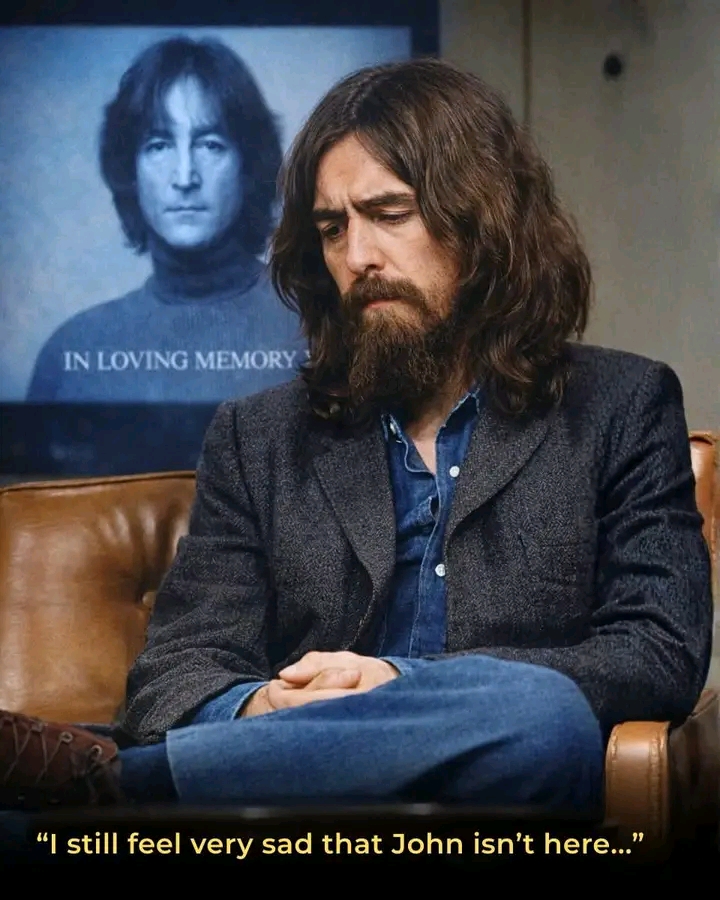
December 8, 1980 is remembered for what the world lost. But in the quiet hours that followed, it was also about how those closest to John Lennon tried to understand what had just happened.
When the news reached George Harrison in England, it came in the early hours of the morning. He was asleep. The phone rang, but he did not answer it himself. Olivia Harrison picked it up, then turned to him with words that were almost impossible to process.
John had been shot.
At first, George did not fully grasp the weight of it. His instinct was to ask how serious it was. Maybe, he thought, it was survivable. A wound, something that could be explained, something that could still be undone. But the answer came back with a finality that left no room for hope.
John was gone.
And then something unexpected happened. George went back to sleep.
On the surface, it sounds distant, even cold. But in reality, it reveals something far more human. Sometimes, when the mind is faced with something too sudden, too overwhelming, it does not react with emotion. It withdraws. Sleep, in that moment, was not indifference. It was distance. A way to delay the full impact of a truth that had arrived too quickly.
When he woke up, the world had not changed back. The news was still there. The loss was still real.
In the years that followed, George rarely spoke about that moment in a dramatic way. Instead, he turned to something quieter, something rooted in his long held spiritual beliefs. He spoke about the idea that life does not end with the body, that the soul continues beyond what we can see. It was not an attempt to explain the tragedy, but a way to live with it.
He once reflected that he believed John understood this too. That beneath the public image, beneath the fame and the contradictions, there was an awareness of something deeper. It was a way of remembering him not as a moment of violence, but as a presence that extended beyond it.
Still, the loss was never abstract.
Shortly after John’s death, George expressed both shock and anger in a way that felt rare for him. He spoke about the act itself as the ultimate violation. Not just the taking of a life, but the intrusion into another person’s existence, taken to its most extreme form.
Years later, that grief found its way into music. A song he had been working on at the time became something else entirely. A tribute. A reflection. A way of speaking to someone who was no longer there, but somehow still present.
What makes George Harrison’s reaction so enduring is not its drama, but its honesty. It did not follow a script. It moved from disbelief, to distance, to reflection, and finally to remembrance.
And in that quiet, complex response, you can feel the weight of losing not just a bandmate, but a part of a life that could never be replaced.