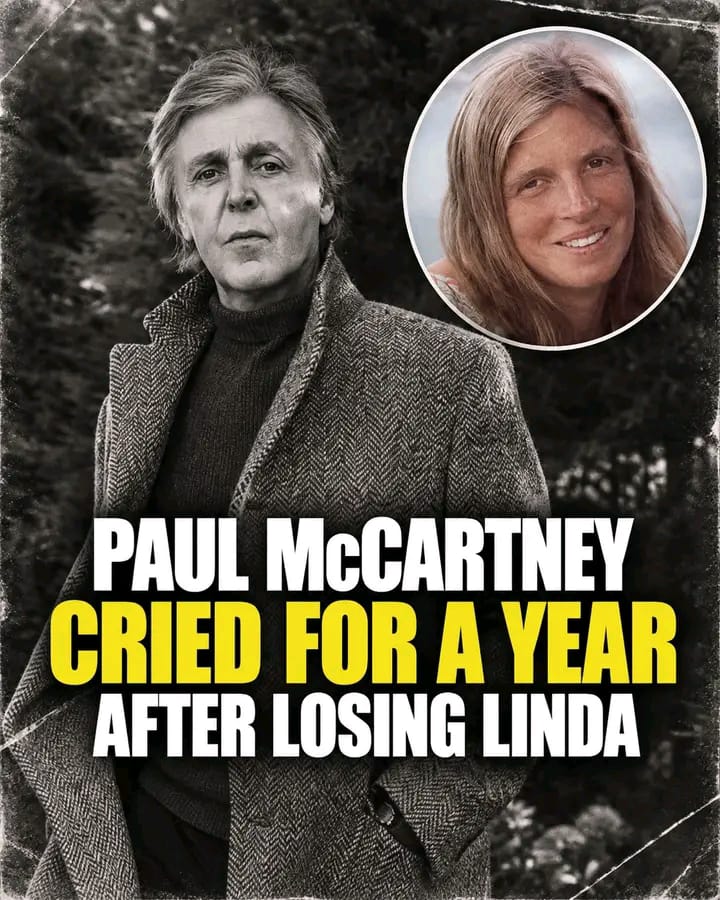
Paul McCartney Cried for a Year After Losing Linda — How He Slowly Learned to Live Without the Love of His Life
For nearly 30 years, Linda McCartney was more than Paul McCartney’s wife. She was his closest companion, his creative partner, the mother of his children, and the person who stood beside him through the extraordinary highs and difficult moments of life after The Beatles.
They shared almost everything. They traveled together, raised their children together, made music together, and built a family life that Paul often tried to protect from the chaos of worldwide fame. Linda was not simply part of his life. She was woven into its everyday details.
Then, in April 1998, everything changed.
Linda died at the age of 56 after battling breast cancer. For Paul, who had spent decades sharing his life with her, the loss was almost impossible to comprehend. The woman he had grown accustomed to seeing beside him was suddenly gone, leaving behind memories, an empty space at home, and a future he had never imagined facing alone.
A Loss That Changed Everything
Paul and Linda married in March 1969, when Paul was already one of the most famous musicians on the planet. Linda, a photographer, brought something into his life that fame could never provide: companionship that felt genuine and a place where he could simply be himself.
Their relationship was built around ordinary moments as much as extraordinary ones. They raised their children, enjoyed family life, worked on music, and developed a shared passion for animal rights and vegetarianism.
Linda also joined Paul musically, performing with him in Wings and helping create a new chapter in his career after The Beatles broke apart.
Their partnership was not without criticism or challenges, particularly when Linda faced harsh reviews for her musical performances. But they continued moving forward together, seemingly comfortable with the fact that their life did not have to satisfy everyone else.
For Paul, Linda was the person who had been there through it all.
When she died, he lost not only his wife but also the person with whom he had built the daily rhythm of his life.
“I Cried for a Year”
Paul later spoke openly about the depth of his grief. He described crying for roughly a year after Linda’s death, a revelation that offered a glimpse into the private pain behind one of the world’s most recognizable public figures.
Grief did not disappear simply because he was Paul McCartney. His extraordinary musical achievements could not protect him from the ordinary devastation of losing someone he loved.
There were no stadiums large enough, no songs powerful enough, and no amount of fame that could replace Linda’s presence.
He had to face the small, painful realities of life without her: the memories attached to familiar places, the absence of her voice, and the realization that the person with whom he had expected to grow old would no longer be there.
For someone who had shared nearly three decades of life with another person, learning to live alone meant learning an entirely different way of existing.
And Paul did not pretend that it was easy.
Music Became One Way to Keep Moving Forward
Throughout his life, music had been Paul’s way of expressing feelings that ordinary conversation could not always capture. After Linda’s death, it remained an important part of how he processed his emotions and continued living.
But returning to music did not mean he had forgotten Linda or suddenly overcome his grief. It meant that life was continuing, even when a part of him was still trying to understand what had happened.
Paul had spent years writing songs about love, loss, hope, and memory. Now, those subjects had become deeply personal in a new way.
He could continue creating, performing, and connecting with audiences while privately carrying the pain of losing his wife. His public life and private grief existed side by side.
Music offered him something familiar to hold on to when so much else had changed.
His Family Gave Him Reasons to Keep Going
Paul and Linda had built their life around their children and family. After Linda’s death, those relationships remained an important part of the world they had created together.
Their children — Heather, Mary, Stella, and James — were also dealing with the loss of Linda in their own ways.
Paul was not the only person grieving. He was also a father whose family had lost someone central to their lives.
Continuing to care for his children, maintaining family connections, and preserving the life he and Linda had built gave him reasons to keep moving forward.
There was no simple moment when the pain vanished. Instead, life gradually began to take on a new shape.
The family could remember Linda, talk about her, and continue the traditions that mattered to them without pretending that her absence did not hurt.
In many ways, keeping those memories alive was another way of keeping her presence in their lives.
He Found Love Again Without Replacing Linda
In the years following Linda’s death, Paul eventually opened himself to another relationship.
He began dating Heather Mills in 1999, and they married in 2002. Their marriage later ended in divorce, but the relationship marked a new chapter in Paul’s personal life.
Some people may imagine that falling in love again means leaving an earlier love behind. Real life is rarely that simple.
Loving someone new does not erase the relationship that came before. It does not remove shared memories, undo years of companionship, or make a profound loss less meaningful.
Linda had been part of Paul’s life for nearly 30 years. No future relationship could change that history.
Moving forward was not the same as moving on from Linda in the sense of forgetting her. It was learning that he could carry the love and memories of his first wife while continuing to experience life.
Linda Never Truly Disappeared From His Story
Even decades later, Linda remains an important part of Paul’s personal history. Their photographs, family memories, musical collaborations, and shared work for animal welfare continue to tell the story of a partnership that extended far beyond celebrity.
Paul has continued performing and releasing music, building new experiences while acknowledging the importance of the life he shared with Linda.
Her influence also remains visible in the values and causes they supported together.
Perhaps that is one of the most meaningful aspects of their story: Linda’s life did not become insignificant because it ended, and Paul’s love for her did not have to end with it.
The people we lose continue to shape us through the memories we keep, the lessons we carry, and the lives we build afterward.
Learning to Live With Loss
Paul McCartney’s experience offers no magical formula for overcoming grief. There is no fixed timetable for healing, and there is no guarantee that the pain will disappear completely.
Sometimes, learning to live without someone means getting through a day that once seemed impossible. Sometimes it means returning to work, spending time with family, or discovering that a moment of happiness no longer feels like a betrayal of the person who died.
And sometimes, it means crying for a year before discovering that life can still offer moments of peace.
Paul had spent nearly three decades sharing his world with Linda. When she died, he had to learn how to inhabit that world differently.
He continued making music. He remained close to his family. He eventually found new companionship and new experiences. Yet none of those things could rewrite the years he had spent with Linda.
Perhaps that is the real answer to how Paul slowly learned to live without her.
He did not need to stop loving Linda in order to continue living. He needed to discover how to live with the absence of someone who had once been present in almost everything.
For nearly 30 years, Linda had been beside him through ordinary mornings, family dinners, musical adventures, and the unpredictable turns of life.
After she was gone, those memories remained.
And sometimes, the most profound form of healing is not forgetting the person you lost. It is learning how to carry their love into a life they can no longer share with you.