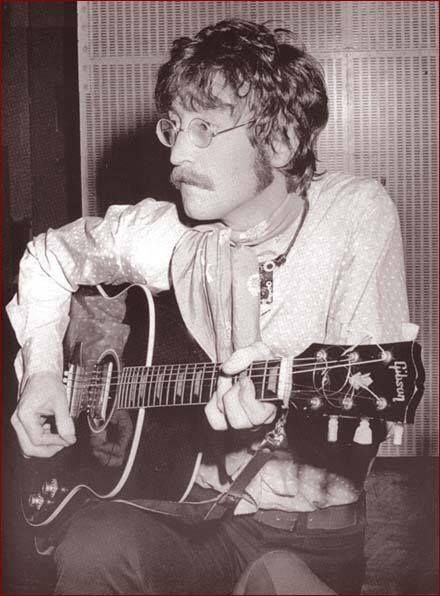
In April 1970, The Beatles finally split up, leaving the music world to mourn the divorce of rock music’s most influential group.
This news came as a shock for some fans, but for many, including the members and their close friends and family, it was an inevitability. In retrospect, we know tensions were reaching a boiling point in the late 1960s, but at the time, public word of such friction was limited and subject to conjecture. Over the years since, some fans blamed the all-consuming nature of the relationship between John Lennon and Yoko Ono, while others blamed overcrowding of talent and a battle of the ego.
As Paul McCartney claimed in a recent interview with Conan O’Brien at the Tribeca Festival, Lennon “had a really tragic life” and cited a number of extremely personal events that shaped the budding musician’s own personality traits.
“As a kid, his mother was decreed to not be good enough to bring him up…His father had left the home when John was three,” McCartney continued. “So that’s not too wonderful. John grew up with these sort of little minor tragedies through his life… It made me realise why he had that vulnerability. I always admired the way he dealt with it because I’m not sure I would deal with the stuff he went through that well.”
Patently heard on Lennon’s first post-Beatles album, John Lennon/Plastic Ono Band, was a keenness to address more personal problems. ‘Mother’ heard Lennon using Arthur Janov’s primal scream therapy to lament his case of parental separation. Further to the sexual side of Lennon’s relationship with Ono, she served as a mother figure, a headstrong presence he could confide in.
Despite this strong familial bond, Lennon entered what would become known as his ‘Lost Weekend’ in 1973: 18 months marked by a romantic affair with May Pang, a production coordinator who worked on his and Ono’s music. Following a significant spell of marital issues, Ono and Lennon separated as Lennon embarked on a short-lived relationship with Pang. Lennon would later return to Ono, deeply regretting this period.
Contrary to expectation, Ono was fully aware of Lennon’s affair and understood it as a transient fling. She welcomed Lennon back with open arms as he expressed public regret for his infidelity.
“It was kinda obvious what ‘Starting Over’ was about,” David Sheff, the Playboy writer who conducted the last major interview with Lennon, once told Mojo. “He’d been untrusting of Yoko, she’d been untrusting of him, all that kind of stuff. But in that one song was this incredible optimism and joy.”
Discussing the song in his last interview with Rolling Stone in 1980, Lennon said: “All through the taping of ‘Starting Over,’ I was calling what I was doing ‘Elvis Orbison.’ It’s like Dylan doing Nashville Skyline, except I don’t have any Nashville, being from Liverpool. So I go back to the records I know – Elvis and Roy Orbison and Gene Vincent and Jerry Lee Lewis.”
Lennon has never been shy to admit the huge influence these legendary rockers had on his life. Despite The Beatles diversion into mystical pop music or psychedelic pomp, for the most part, Lennon was a rocker at heart. “That’s the music that inspired me to play music,” explained the singer.
“There’s nothing conceptually better than rock ‘n’ roll. No group, be it the Beatles, Bob Dylan, or the Rolling Stones, has ever improved on ‘Whole Lotta Shakin’ Goin’ On’ for my money. Maybe I’m like our parents, that’s my period. That’s my period, and I’ll never leave it,” Lennon mused.
Elvis Presley and Roy Orbison represented the zenith of total rock balladry. As able to shake things out as they were, they penned a love song that could break your heart. It feels fitting that it should be these two acts to which Lennon would feel indebted. More so than any artist of the 1960s, Lennon channelled the persona of these stars.
Listen to the tragically optimistic ‘(Just Like) Starting Over’ below.