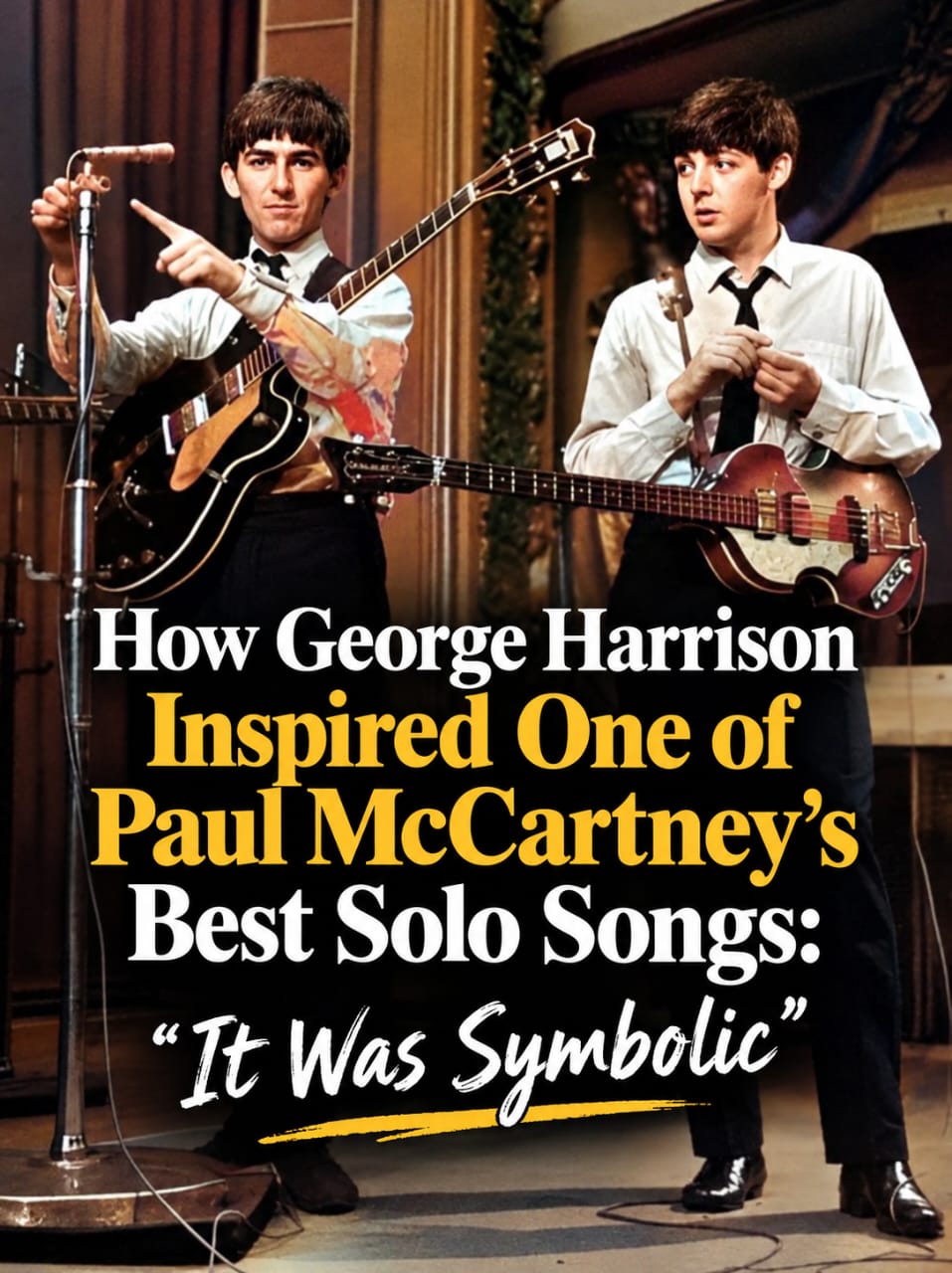
How George Harrison Inspired One of Paul McCartney’s Best Solo Songs: “It Was Symbolic”
The friendship between Paul McCartney and George Harrison was one of the most important relationships in the history of The Beatles. Together, they helped change popular music forever. But beyond the screaming fans, legendary recordings, and unforgettable performances, their relationship was also shaped by years of shared memories, creative differences, and the complicated emotions that came with growing older.
After The Beatles broke up in 1970, both musicians followed their own musical paths. McCartney built a successful solo career, while Harrison established himself as a songwriter with a distinctive spiritual outlook and a sound that went far beyond his role as the band’s lead guitarist.
Yet even as their lives moved in different directions, their shared history continued to influence their music.
One particularly fascinating story concerns how Harrison inspired McCartney’s solo work—and why the idea that something could be “symbolic” carried such meaning.
A Friendship That Began Before the World Knew Their Names
McCartney and Harrison first became friends as teenagers in Liverpool. Long before Beatlemania, stadium concerts, and worldwide fame, they were simply young musicians trying to master their instruments and find their sound.
Harrison was younger than McCartney, but his musical abilities quickly made him an important part of the group. As The Beatles developed, Harrison became known for his inventive guitar playing and increasingly confident songwriting, contributing classics such as “While My Guitar Gently Weeps,” “Something,” and “Here Comes the Sun.”
McCartney, meanwhile, emerged as one of the band’s principal songwriters, creating melodies that would become part of popular music history.
Their partnership was not always easy. The Beatles’ creative environment could be intensely competitive, and Harrison sometimes struggled to secure the same attention for his compositions that McCartney and John Lennon received.
Nevertheless, their musical relationship endured through the band’s most successful years and beyond.
When the Beatles’ Story Became Personal
The breakup of The Beatles changed everything. The four musicians were no longer working together every day, and each had to establish an identity outside the group that had defined their lives.
For McCartney, the transition was especially difficult. He began recording independently before forming Wings with his wife, Linda, and other musicians. Harrison, meanwhile, released All Things Must Pass in 1970, an ambitious solo album that demonstrated just how many songs he had developed during his time with The Beatles.
Although the former bandmates occasionally collaborated, their relationship was no longer the same as it had been in Liverpool.
That history makes the connections between their solo careers particularly interesting. Sometimes, the influence of one Beatle on another was not simply about musical technique or songwriting. It could also involve a shared memory, a personal gesture, or a symbol that carried meaning because of everything they had experienced together.
The George Harrison Line That Helped Inspire “Band on the Run”
The song at the center of this story is
The title track of the album Band on the Run tells a story of confinement, escape, and freedom. Its changing musical sections take listeners from a feeling of imprisonment toward the exhilaration of breaking free.
The inspiration had a connection to the difficult final years of The Beatles.
During that period, the band’s business problems and internal disagreements increasingly overshadowed the simple pleasure of making music. Harrison reportedly expressed frustration during a Beatles business meeting with the idea of getting out of the situation. McCartney later connected that feeling to the song’s opening theme.
In a 2010 interview with Clash, McCartney explained the significance of the idea:
«“It was symbolic.”»
He went on to describe how The Beatles had started as young musicians with modest ambitions but eventually found themselves caught up in business meetings and other complications. The feeling of wanting to escape had become part of their experience.
There is an important distinction, however: McCartney said he did not clearly remember the phrase as an exact line spoken by Harrison. He acknowledged the connection to that period while explaining that the song represented a broader feeling rather than simply reproducing a specific remark.
A Song About More Than Prison Bars
One of the reasons “Band on the Run” remains so memorable is that its story works on several levels.
On the surface, it follows people trying to escape confinement. But the idea of being trapped can also describe a situation in which freedom has gradually disappeared under the weight of expectations, responsibilities, and conflict.
For McCartney, the experience of The Beatles’ final years provided a powerful emotional background for that theme.
The band had begun as a group of friends united by music. Their success brought extraordinary opportunities, but it also created pressures that the teenage musicians could hardly have imagined when they first started playing together in Liverpool.
The song transformed that complicated history into something listeners could understand without knowing every detail of the band’s internal disputes.
Its movement from tension to release also makes the music itself feel like an escape. Rather than remaining in one musical setting, the recording develops through contrasting sections, giving it the character of a miniature rock adventure.
Why George Harrison’s Influence Matters
Harrison’s importance to the story is not that he necessarily sat down with McCartney and deliberately helped write the finished song. Instead, his reported expression of frustration captured a feeling that McCartney later transformed into art.
That is a different kind of songwriting influence: a passing remark, shaped by a shared experience, becomes part of a much larger creative idea.
It also reflects the complicated relationship between the former Beatles. Their partnership had included extraordinary musical achievements, but it had also involved disagreements and the pressures of a business that had grown far beyond the ambitions of four young musicians.
By the time McCartney recorded Band on the Run with Wings, he was building a new musical identity. The song’s escape theme could therefore speak both to his memories of The Beatles and to his determination to move forward independently.
From the End of The Beatles to a New Beginning
Released in 1973, Band on the Run became a defining album of McCartney’s solo career. The title track helped establish Wings as a serious musical force and demonstrated that McCartney could create ambitious, distinctive work beyond the band that had made him famous.
The irony is that a song celebrating escape drew part of its emotional meaning from a difficult chapter in music history.
Harrison’s reported frustration became associated with a song about breaking free, while McCartney used that broader feeling to create something that reached far beyond the circumstances in which it originated.
That is what makes the story so compelling. Sometimes, a great song does not begin with a carefully planned lyric or a dramatic moment. Sometimes, it begins with an ordinary expression of frustration that captures exactly how people feel.
George Harrison’s connection to “Band on the Run” reminds us that the history of The Beatles continued to influence their music even after the band itself was gone. McCartney took a feeling rooted in their shared past and turned it into a song about freedom, possibility, and the courage to start again.